Start where the weave meets the wood. A row of little holes, a narrow groove, or a strand wrapped around a rail can tell you how the seat was made. Here are the five kinds of work you’ll find at Seat Renewal in Pekin, Illinois.
Reading the weave
Hand-woven cane
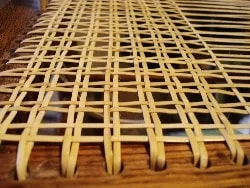
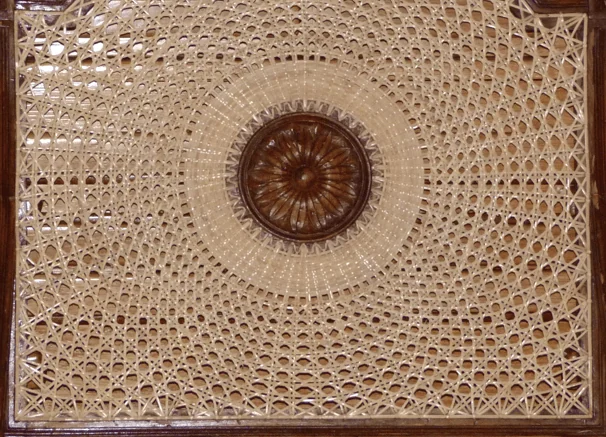
Look under the rim. Little loops joining one hole to the next are the signature of hand caning. Each narrow strip of rattan cane travels through the wood. Lengthwise, crosswise and diagonal strands build the familiar pattern of eight-sided openings.
The spacing of the original holes helps determine the width of the replacement cane. A binder strand finishes the border where wood and weave meet.
Pressed or prewoven cane
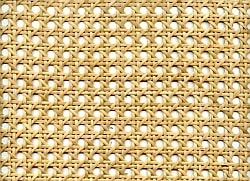
The open pattern can look just like hand caning. Follow the edge with your eye. A continuous strip of trim, called a spline, holds a sheet of cane webbing in a groove around the seat or back.
Renewal starts at that groove. The old spline and webbing come out, the new sheet is aligned with the frame, and a fitted spline holds the weave in place.
Splint weave
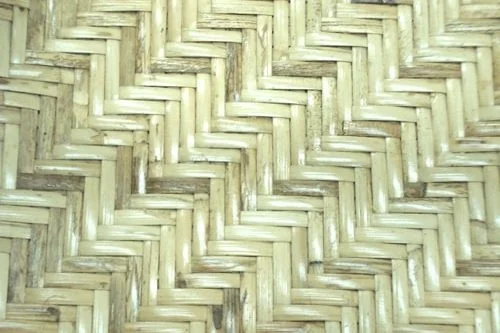
Broad, flat strips cross the seat and turn around the rails. On a herringbone seat, the diagonal lines change direction to make small chevrons. A basket weave forms a more squared-off pattern.
Traditional splints were split from woods such as ash, oak and hickory. Flat rattan reed is another material used for this work. A surviving corner gives the weaver clues to both the strip width and the original pattern.
Blind and double-blind caning
On a blind-caned panel, the holes stop inside the wood. Each strand is cut to length and fixed in a shallow hole. Turn the panel over and the reverse face of the frame has no through-holes or loops.
Double-blind work repeats the process on the reverse face, creating two separate woven surfaces. On an ornate back or arm, the weaver must fit each length to the shape of the frame.
Fiber and natural rush
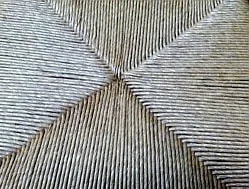
Four triangular fields meet like the folds of an envelope. The weaver carries the strand around the seat rails, building the seat inward from its corners. You’ll often see this construction on ladder-back chairs.
Fiber rush is twisted kraft paper. Natural rush is made from plant material such as rush stems or cattail leaves. Both produce a corded surface. The old seat and the shape of its rails help identify the appropriate replacement.
Before you bring it in
Planning your repair
What if most of the old weave is missing?
Keep any remaining strands with the chair. The border, underside, rail shape and surviving weave can help identify the method. You can call Doll Furniture Company even if you’re unsure which weave you have.
Will the new cane match my chair?
Fresh cane can look pale against an older wood frame. Many chairs need a custom color and finish to bring back their original look or help the new weave blend with the surrounding wood. Doll Furniture Company handles that finishing work and can also repair a loose joint or refinish a worn frame.
What should I have ready for an estimate?
It helps to have the chair nearby when you call Doll Furniture Company. Describe which parts need work, how many pieces you have, and what you can see around the edge. Ask whether a photograph would help with the estimate.
Where do I take my chair?
Seat Renewal picks up chairs at Doll Furniture Company, 400 North Beech Street, Normal, IL 61761. Call 309-452-2606 for an estimate and to arrange your drop-off.